Category archive

health

Coronavirus: London placed on Covid-19 watch-list as cases rise
in health

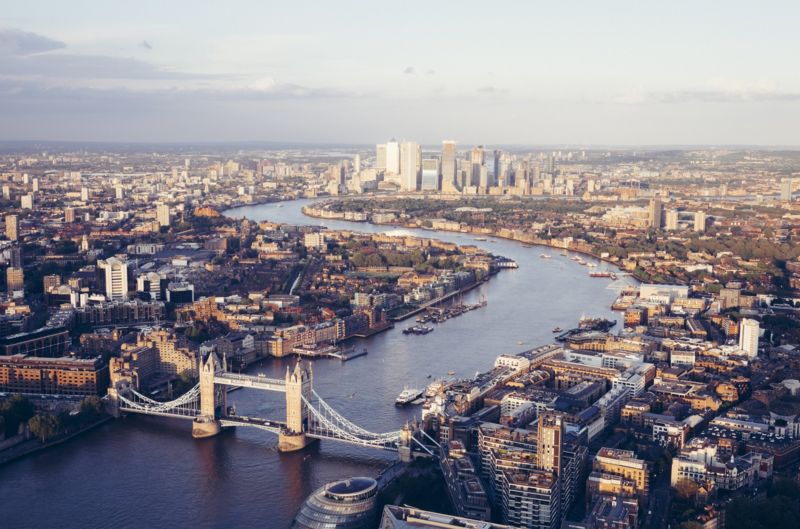
Due to the rise in cases in the city, officials have said, London has been added to the government’s Covid-19 watch-list.

All boroughs have been classed as areas of concern, but no additional restrictions have been announced.

Mayor of London Sadiq Khan said the city was at “a worrying tipping point” with hospital admissions increasing.

Councils in the city have urged residents to abide by current restrictions.

The watch-list, published each week, categorises local councils seeing a higher infection rate as “areas of concern”, “areas of enhanced support” or “areas of intervention”.

Tighter restrictions are usually introduced for areas in the third category.

Earlier on Friday, London Councils – the group representing all 33 local authorities in the city – announced the city would be joining the list, saying it was a “stark reminder” to residents they must follow new rules announced this week.

The organisation called for a sustained boost to Covid-19 testing in the capital so infections can be monitored.
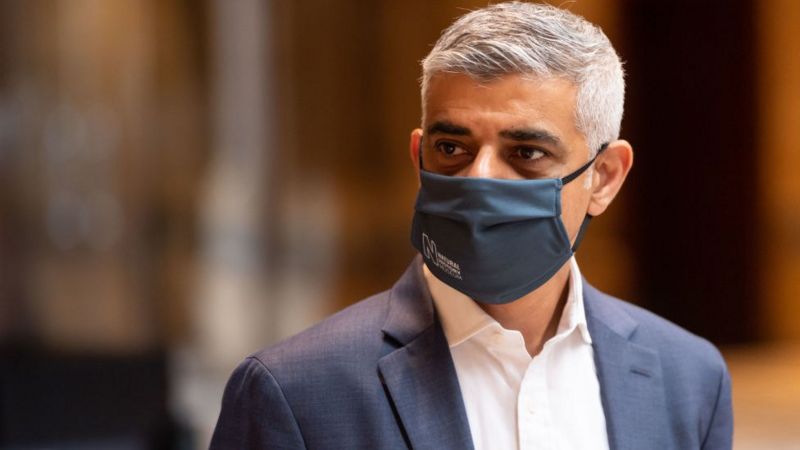
Sadiq Khan said the city had seen “a sharp rise” in NHS 111 calls, hospital admissions and patients in intensive care due to coronavirus

Mr Khan said testing capacity had been “diverted away” from the capital to other national hotspots, causing the number of tests in the city to drop by 43%.

“The lack of testing capacity is totally unacceptable,” he said.

“It’s vital that testing capacity is increased immediately in London and focused in the areas it is needed most. Any delay will mean letting the city down and will cost lives.”
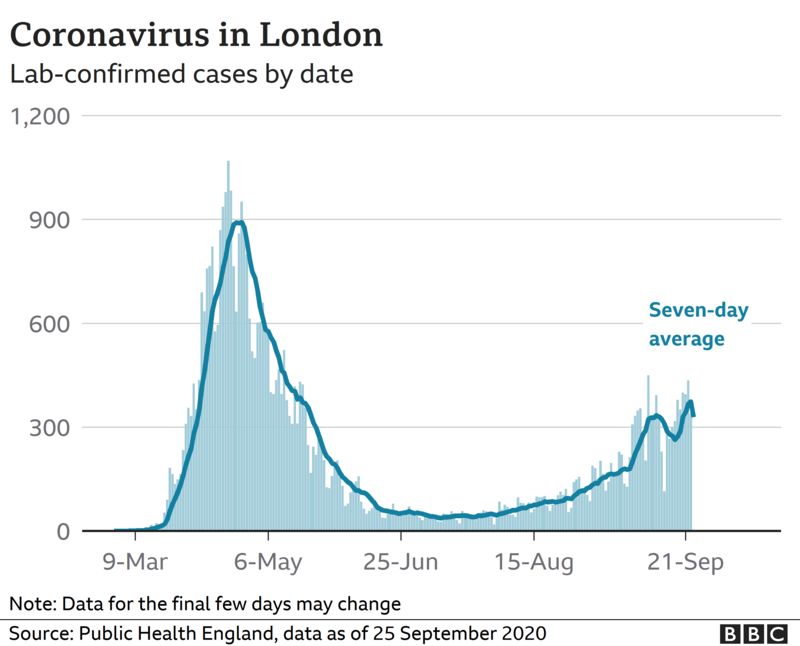
The most recent daily figures showed 584 coronavirus cases were reported across London. In the week to 21 September, Redbridge had the highest infection rate per 100,000 residents compared with other boroughs, at 55.4.

All content belongs to bbc.com

We do not claim any content to be our own.
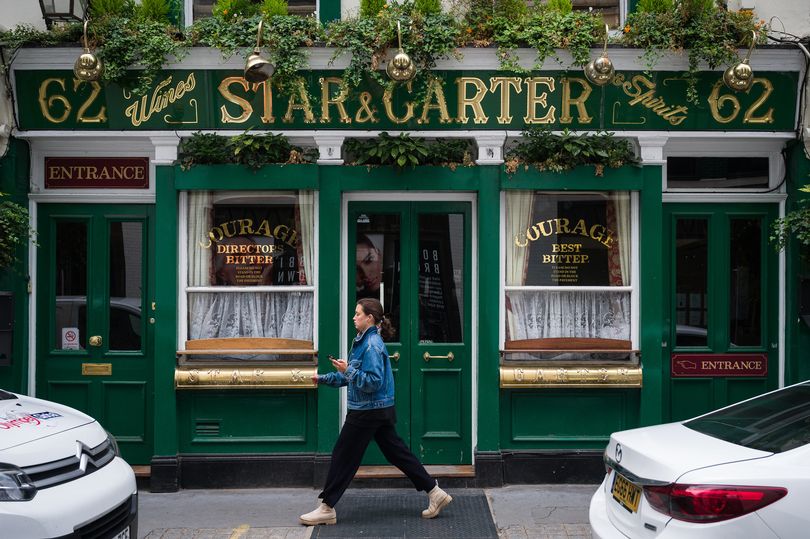
London coronavirus: What a London lockdown could look like as city may be ‘days behind’ North East

in health

More areas of the UK are speculated that could see coronavirus restrictions extended in the coming weeks.

London Mayor Sadiq Khan is pressing ministers to extend the controls to London, which he believes may be just “two or three days” behind the hotspots of the North West and North East of England.

In the face of heightened criticism the government has made a series of announcements in the last 24 hours signalling an increasing tougher approach to the coronavirus outbreak.

The government announced yesterday (September 19) anyone in England who refuses an order to self-isolate could face a fine of up to £10,000.

Health Secretary Matt Hancock spoke this morning and warned Britain is at a “tipping point” as he refused to rule out a second national coronavirus lockdown if the public fails to follow social distancing rules.

With cases rising across the country, Mr Hancock said there was a danger the numbers could “shoot through the roof” unless effective action was taken to halt the spread of the virus.

Much of the countries population are already living under increased restrictions, so when considering what may happen in London over the next few weeks, if infection rates continue to rise, it makes sense to look at what is already in place across the UK.

People in the North East, North West and the Midlands are all living under tighter coronavirus, as is Bolton, which has the highest infection rate in the UK.

Below you will find the coronavirus rules in some areas of England that could soon be arriving in London:

North East

Durham, Gateshead, Newcastle, Northumberland, North Tyneside, South Tyneside and Sunderland

Hospitality venues must only sell food and drink for consumption on the premises if it is served to customers sitting at a table – they may also sell food and drink for consumption off the premises.

Hospitality venues include: Restaurants (including hotel dining rooms and members’ clubs), cafes, bars (including bars in hotels or members’ clubs), pubs, social clubs and casinos.

The following businesses and venues must close from 10pm to 5am each day:

  • Restaurants, including hotel dining rooms and members’ clubs
  • Cafes
  • Pubs
  • Bowling alleys
  • Social clubs
  • Cinemas
  • Theatres
  • Casinos
  • Amusement arcades or other indoor leisure centres or facilities
  • Funfairs (indoors or outdoors), theme parks and adventure parks and activities
  • Bingo halls
  • Concert halls

If you live in one of the affected areas, you must not:

  • Host people you do not live with in your home or garden, unless they’re in your support bubble.
  • Meet people you do not live with in their home or garden, whether inside or outside of the affected areas, unless they’re in your support bubble.

You should also try not to share a car with those outside your household or support bubble.

Bolton

The following businesses and venues must not open in Bolton:

Casinos

Skating rinks

Bowling alleys

Indoor play areas, including soft play areas

Exhibition centres and conference halls for external attendees

Hospitality venues must only provide take away food and drinks or delivery services to customers – this includes restaurants, cafes, bars, pubs.

The following businesses and venues must close from 10pm to 5am each day:

Venues listed above (now only operating as takeaways)

Cinemas

Theatres

Bingo halls

Concert halls

Museums and galleries

Betting shops

Nail bars and salons, hair salons and barbers

Tanning booths and salons

Spas and beauty salons

Massage parlours

Tattoo and piercing parlours

Amusement arcades or other indoor leisure centres or facilities

Funfairs (indoors or outdoors), theme parks and adventure parks and activities

Playgrounds

Social clubs

Aquariums and zoos, including safari parks

Indoor attractions at visitor attractions

If you live in Bolton, you must not:

Host people you do not live with in your home or garden, unless they’re in your support bubble.

Meet people you do not live with in their home or garden, whether inside or outside of Bolton, unless they’re in your support bubble.

You should also try not to share a car with those outside your household or support bubble.

West Midlands

Birmingham, Sandwell, Solihull and Wolverhampton (from Tuesday 22 September)

If you live in the affected local areas, you must not:

  • Host people you do not live with in your home or garden, unless they’re in your support bubble.
  • Meet people you do not live with in their home or garden, whether inside or outside of the affected areas, unless they’re in your support bubble.

You should also try not to share a car with those outside your household or support bubble.

North of England

Greater Manchester, East Lancashire, Preston, and West Yorkshire

If you live in one of the affected areas, in order to help prevent the spread of coronavirus you must not:

  • Host people you do not live with in your home or garden, unless they’re in your support bubble.
  • Meet people you do not live with in their home or garden, whether inside or outside of the affected areas unless they’re in your support bubble.

You should also try not to share a car with those outside your household or support bubble

All content belongs to mylondon.news

We do not claim any content to be our own.


Covid-19: Tighter national rules considered for England by government

in health

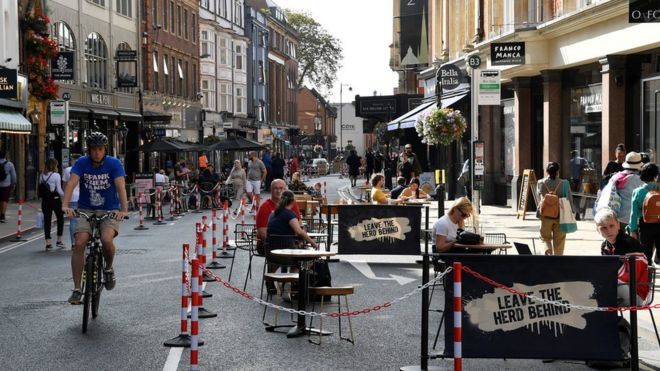
For a few weeks pubs and restaurants could be shut  as part of stricter measures across England to slow the surge of coronavirus cases.

The government is considering a short period of tighter rules which could be announced in the next week, BBC political editor Laura Kuenssberg said.

Schools and most workplaces would be kept open during those weeks.

Health Secretary Matt Hancock told the BBC the government is “prepared to do what it takes” against Covid-19.

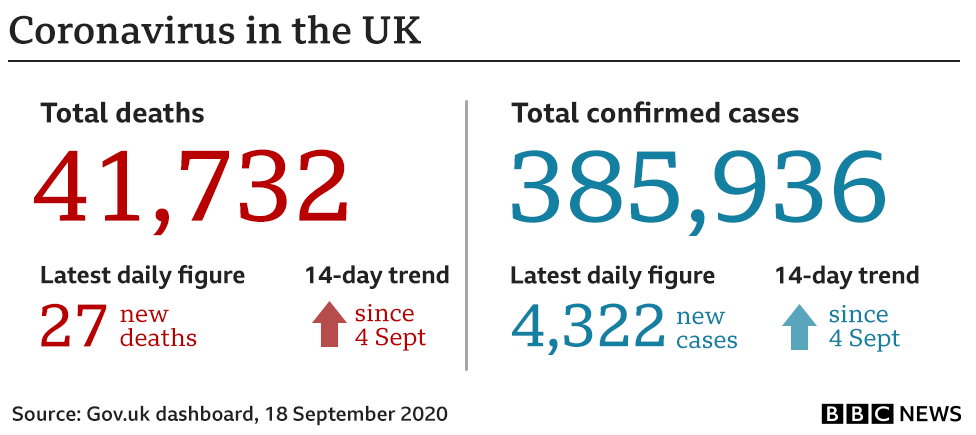
It comes as the UK recorded a further 4,322 confirmed cases of coronavirus – the first time the daily total of positive tests has exceeded 4,000 since 8 May.

Another 27 deaths were reported within 28 days of a positive test.

Described by the government as a “circuit-break”, the measures being considered could involve re-introducing restrictions in public spaces for a period of a few weeks. Schools and workplaces would stay open.

Ideas suggested by the government’s Scientific Advisory Group for Emergencies (Sage) include closing some parts of the hospitality sector.

No 10 is also considering limiting the opening hours of pubs and restaurants across the country, as has already happened in some areas.

Mr Hancock said there had been an “acceleration” in cases in the last couple of weeks, with the number of people admitted to hospital doubling about every eight days.

He stressed it was “critical” that people followed social distancing guidelines and local lockdown rules, where they applied, to “avoid having to take serious further measures”.

The Office for National Statistics’ weekly infections survey for England and Wales, used by the government to base its decisions, estimates there were about 6,000 new cases a day in England in the week to 10 September.

‘Circuit-break’

Scottish First Minister Nicola Sturgeon has said the next few days will be “critical” to avoid another full-scale lockdown in Scotland.

Ms Sturgeon, Welsh First Minister, Mark Drakeford, and Labour leader Sir Keir Starmer have all asked Boris Johnson for an emergency Cobra meeting to be called.

At a meeting on Wednesday night, the UK government’s chief scientific adviser and medical adviser said they were forecasting a significant number of deaths by the end of October if there were no further interventions.

Basic maths shows us how quickly coronavirus cases can, theoretically, soar.

Around 4,000 infections a day, doubling every eight days, would be 128,000 new daily cases by the end of October.

That is not guaranteed to happen, and a change in our behaviour, the “rule of six” or restrictions like those in north-east England could improve the situation.

The point of a national “circuit-break” would be to achieve a controlled drop in the levels of coronavirus without needing a full lockdown.

This does two things, obviously it helps avoid having very high levels of the virus that could overwhelm hospitals.

But it also gives us more options. Any contact tracing programme or system of local lockdowns is far easier to implement when levels of the virus are low. The higher the number of cases, the fewer targeted measures the government has to use.

The problem is once the circuit-break is over, cases would begin to rise again and it may take multiple circuit breaks to get us through winter.

Meanwhile, new rules have been announced for north-west England, the Midlands and West Yorkshire, to come into force from Tuesday, in an effort to control the spread of the virus.

Similar restrictions have already come into force in north-east England, affecting almost two million people, banning them from meeting people from other households and requiring restaurants and pubs to shut at 22:00 BST.

But it is understood the government turned down down a request from the local council in Leeds to bring in early closing for bars and pubs there.

Other parts of the UK under local lockdown conditions include – including Birmingham, Greater Manchester, Caerphilly, and the Belfast council area.

The four nations of the UK are in charge of their own lockdown restrictions, with Scotland, Wales and Northern Ireland implementing slightly different rules to England.

The health secretary said the government’s current approach was “targeted interventions” and stressed “a national lockdown was the last line of defence”.

“The strategy is to keep the virus down as much as is possible whilst protecting education and the economy,” Mr Hancock added.

“And throw everything at the science which eventually is the way we’re going to spring out of this.”

Prime Minister Boris Johnson is understood to be deeply reluctant to order another national lockdown, where everyone would be asked to stay at home and businesses to close.

Earlier this week he described the potential impact of this on the economy as “disastrous”. Chancellor Rishi Sunak is also understood to have warned ministers of the potential damage to the economy.

The government is also concerned about the impact of more restrictions on daily life on those who need treatment for non-Covid related illnesses.

In other key developments:

All content belongs to bbc.com

We do not claim any content to be our own.

 

Coronavirus: England and Wales’ contact-tracing app gets launch date

in health

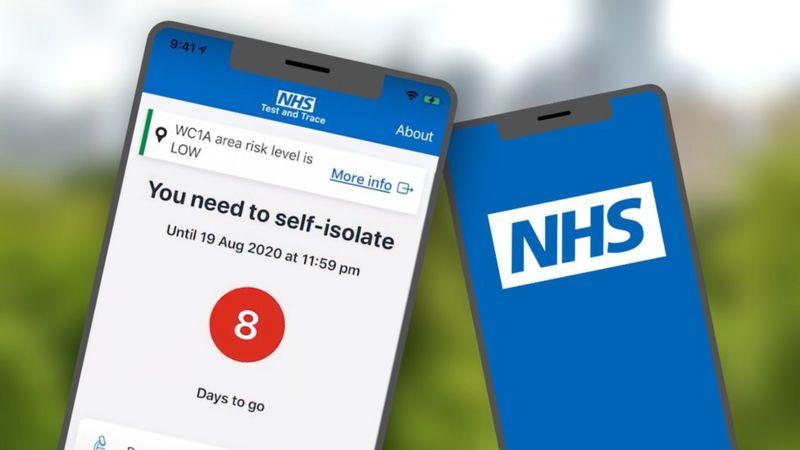
The government has announced that on 24 September, a new Covid-19 contact-tracing app will be launched across England and Wales.

The app will let people scan barcode-like QR codes to register visits to hospitality venues and will implement Apple and Google’s method of detecting other smartphones.

Businesses are being asked to display QR code posters to support the app.

Health Secretary Matt Hancock described the launch as “a defining moment”.

The first version of the NHS contact-tracing app, intended for the whole of the UK, was trialled on the Isle of Wight in May but later abandoned.

“We need to use every tool at our disposal to control the spread of the virus including cutting-edge technology,” said Mr Hancock.

“The launch of the app later this month across England and Wales is a defining moment and will aid our ability to contain the virus at a critical time.”

According to the latest figures published by the Office for National Statistics, there were an estimated 3,200 new cases a day in England during the first week of September, compared with 2,000 the week before.

Some hospitality venues have already been using their own QR code-based systems for test and trace but are now being asked to switch to the NHS version instead.

Universities, hospitals, leisure premises, civic centres and libraries are being asked to display posters in communal areas such as cafes, where people gather for longer than 15 minutes.

An alternative system, such as a handwritten register, must also be maintained for visitors who do not have smartphones, the Department of Health and Social Care said.

Welsh Health and Social Services Minister Vaughan Gething said launching a joint app with England was “the most practical option”.

He added that the move reflects “movement across our shared border”.

“It makes sense to use the same app, working in exactly the same way, regardless of which country you’re in.”

It has had a long and troubled gestation but the team behind the NHS Covid-19 app are hoping that they’ve finally got it right at a time when it can make a significant contribution to limiting the spread of the virus.

Back in April, an app seemed to be a key weapon in the government’s armoury but since Baroness Dido Harding took over the Test and Trace programme, it’s been relegated to the “cherry on the cake”.

Around the world there are still doubts amongst those working on contact tracing apps about just how good Bluetooth is as a way of measuring the distance between people.

But the fact that pubs, restaurants and other hospitality businesses are now being told they have to do a better job of logging contact details of visitors presents an opportunity.

They may now see having QR codes for visitors as a simple way of complying with the rules, and that could encourage take-up of the app.

There has been some confusion about whether businesses will be complying with the rules on collecting customer data if they rely on the app. But I’ve been told that they will be compliant even though the nature of the app means none of the data will be visible either to them or to the authorities.

Scotland launched its own app on Thursday that has already been downloaded nearly 600,000 times.

The Protect Scotland app informs people if they have been in close contact with someone who later tests positive.

Northern Ireland was the first part of the UK to launch a contact-tracing app – StopCOVID NI was officially launched at the end of July.

In England, from Monday, social gatherings will be limited to up to six people – in a measure dubbed “the rule of six”.

It has been criticised by some Conservative MPs who have said it should be subjected to more parliamentary scrutiny.

Scotland and Wales – which along with Northern Ireland have devolved powers to set their own coronavirus restrictions – also reduced the size of social gatherings to six people from Monday.

In Scotland, children under the age of 12 will not count towards the total, and in Wales the rule will not apply to children under 11 and up to 30 people can still meet outside.

The new measures followed a sustained rise in coronavirus cases, with over 2,000 positive cases recorded across the UK on five consecutive days this week.

All content belongs to bbc.com

We do not claim any content to be our own.
Campaign to train 1,000 residents in mental health first aid

in Croydon/health

A course open to all Croydon residents is being offered to help people become mental health first aiders funded by Croydon Council and Transport for London.

The campaign comes after the mental health charity Mind revealed the scale of the impact of the coronavirus on mental health. More than one in five adults with no previous experience of mental health problems said their mental health is now poor or very poor following a survey over the summer.

In response the council and Croydon Covid-19 Mutual Aid – a voluntary network launched in March – has launched the two-day online course targeting people who are already providing informal support for local residents – whether you’re a sports coach, a trusted auntie or just a neighbour who cares.

“The pandemic has caused incredible loss, stress and uncertainty. However, in the face of huge challenges Croydon’s community has united to support each other and we are encouraging Croydon residents to keep volunteering and take this funded course in order to help others in our community. I am delighted we have been able to fund a thousand places for our mental health first aiders and really value our partnership with Croydon Covid-19 Mutual Aid”

Councillor Janet Campbell, cabinet member for families, health and social care

So far more than 200 applications have been received for the training run by Mental Health First Aid England and more than 100 people have already completed the course. Applications include more than 40 mental health organisations as well as churches, mosques, colleges, businesses, schools and charities.

Rowenna Davis, organiser for Croydon Covid-19 Mutual Aid said, “Whilst the physical suffering from coronavirus is well known, we are all still getting to grips with the mental impact. Many families have suffered directly or even lost loved ones and all of us still feel the pressures of lockdown.

“While volunteers can never replace frontline professionals, residents are often the first ones to recognise when someone they know or love is suffering. This training should help people recognise the signs of developing mental health problems and provide guidance for early intervention.”

To apply for the course email MHFA@croydon.gov.uk

You can find out more on Facebook at ‘Croydon Covid 19 Mutual Aid’ and Twitter @CroydonCovidMA

All content belongs to croydon.gov.uk

We do not claim any content to be our own.
Coronavirus: Further 2,988 cases confirmed in UK

in health

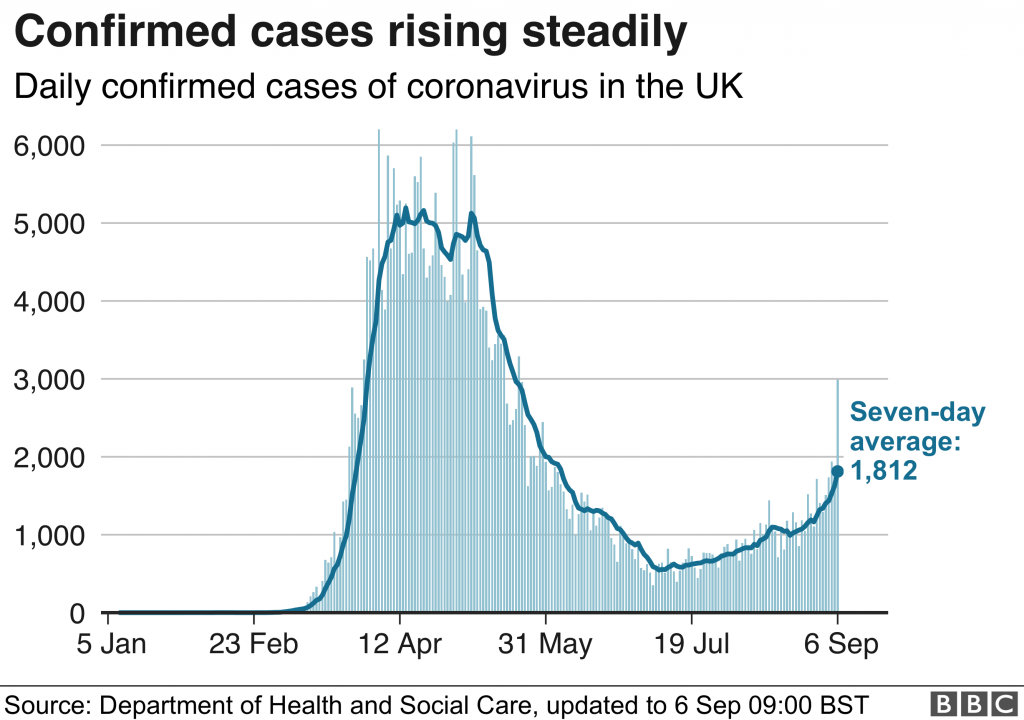
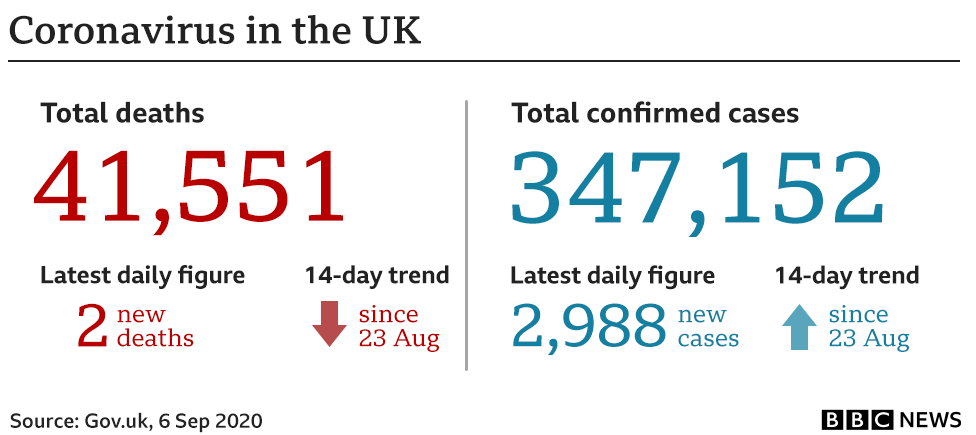
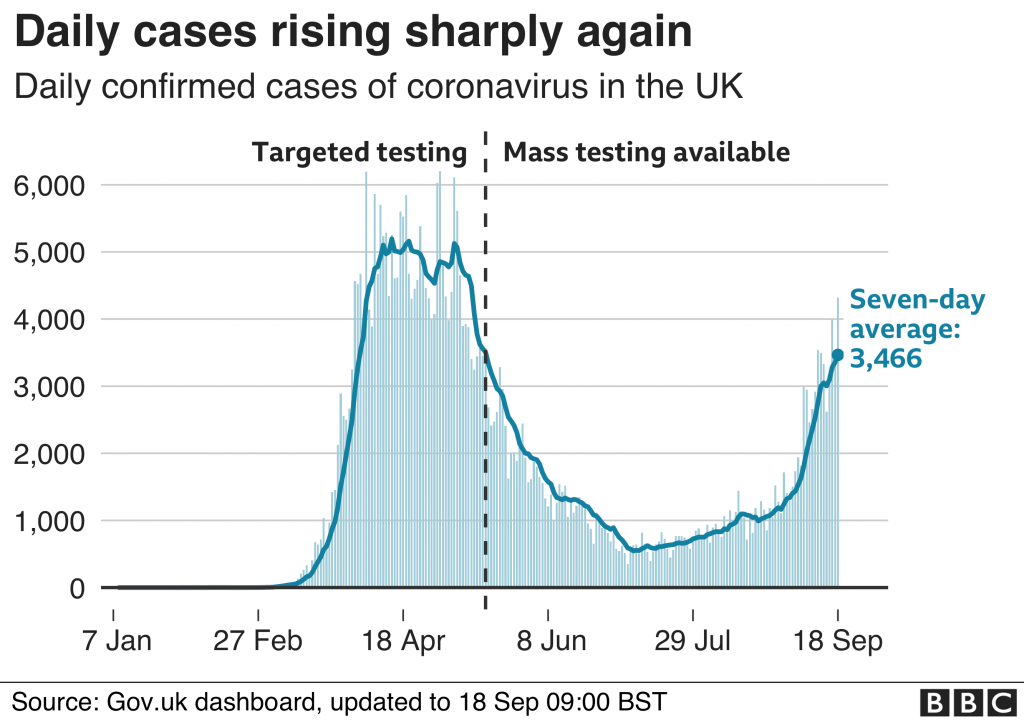
Sunday- September 6, a further 2,988 cases of coronavirus have been reported in the UK, government data showed.

It is the highest number reported on a single day since 22 May and a rise of 1,175 on Saturday, according to the UK government’s coronavirus dashboard.

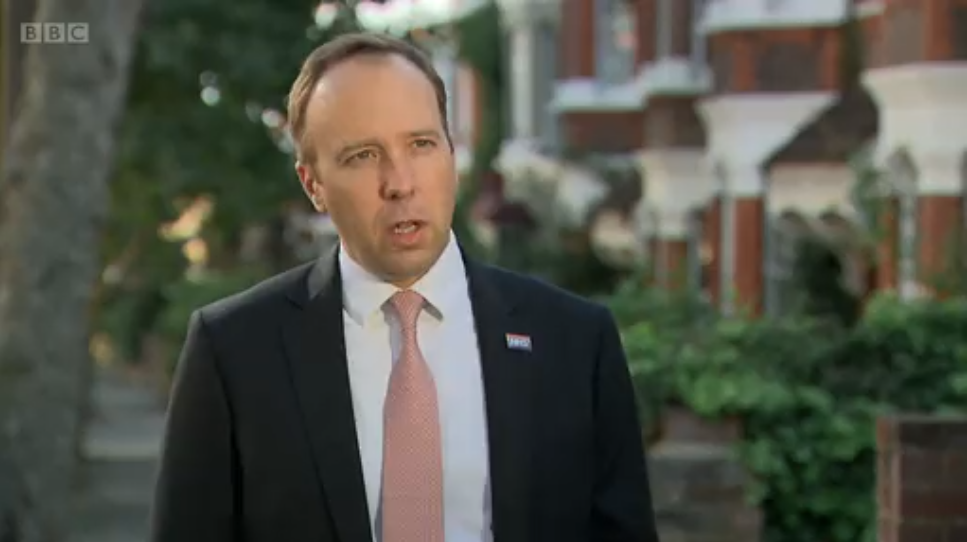
Health Secretary Matt Hancock said he was “concerned” about a rise in cases “predominantly among young people”.

Two further deaths within 28 days of a positive test were recorded, taking the total number of UK deaths to 41,551.

Mr Hancock added: “It’s so important that everybody does their bit and follows the social distancing because it doesn’t matter how old you are, how affected you might be by this disease, you can pass the disease on to others.”

“So don’t pass the disease on to your grandparents if you’re a young person, everybody needs to follow the social distancing.”

Despite the sharp rise in cases, Mr Hancock said the government was right to reopen schools “because of the impact on children of not getting an education”, adding that workplaces which have reopened are “Covid-secure”.

Scotland recorded 208 new cases on Sunday, its highest daily increase for more than 17 weeks.

Wales recorded a further 98 cases, its highest daily rise since 30 June, and Northern Ireland recorded 106 new cases, its highest rise since 25 April.

Overall, since the start of the pandemic, 347,152 cases have been confirmed in the UK.

‘A significant new spike’

The number of daily reported cases has been rising steadily and some of that has been put down to an increase in the number of people being tested.

Put simply, the more you test the more new cases you will find. But the jump of more than one thousand in a day is a significant new spike.

The health secretary says the government is concerned and has renewed official calls for more vigilance on social distancing.

What Matt Hancock and health officials are worried about is that the UK might follow the same path as France and Spain, where increases in infections amongst younger adults led after a few weeks to higher numbers of admissions to hospitals for older and more vulnerable patients.

The number of people seriously ill in hospital with Covid-19 has fallen and there were just two new daily reported deaths.

Medical leaders and ministers can only hope that the spread of the virus amongst younger people does not get passed on to the elderly and those with underlying health problems.

Labour’s shadow health secretary Jonathan Ashworth said ministers needed to “set out what is being done to get testing back on track and bring case numbers down”.

He said the increase in cases came on top of “the ongoing testing fiasco where ill people are told to drive for miles for tests, and the poor performance of the contact tracing system”.

Increased demand led bosses in charge of the coronavirus testing system to apologise after it emerged UK labs were struggling to keep up.

Screening capacity was described last week as being “maxed out” – 170,000 tests a day are being processed, up from 100,000 in mid June.

Prof Paul Hunter, an expert in outbreak response at the University of East Anglia, said some of the rise may be due to the system catching up after delays when it struggled to keep up with demand, but added it was still a “marked increase”.

“Sadly it is beginning to look like we are moving into a period of exponential growth in the UK epidemic, and if so we can expect further increases over coming weeks,” he said.

Birmingham had the single largest increase in cases overnight, and the majority of new cases were in the north of England, said Yvonne Doyle, Public Health England’s medical director.

But she said no single area accounted for the overnight change, with broad increases in Covid-19 cases across England.

The rise in positive tests came as tougher measures limiting household contacts were introduced in Bolton in an effort to stop coronavirus cases rising and prevent a full local lockdown.

The infection rate in the area has risen to 99 cases per 100,000 people per week – the highest in England.

Commenting on Scotland’s increase, First Minister Nicola Sturgeon said: “While this reflects the substantial opening up of the economy, it reminds us of the need to deploy counter measures.”

She added that the “first line of defence” is to “take greater care on face coverings, hygiene and distance”.

Meanwhile, speaking earlier on Sunday, Foreign Secretary Dominic Raab said the economy “needs to have people back at work”.

Mr Raab acknowledged there was likely to be a “bit more” remote working in future.

However, he added: “It is important to send a message that we need to get Britain back up and running, the economy motoring on all cylinders.”

Mr Raab also played down suggestions that coronavirus testing at airports would help travellers avoid mandatory quarantine.

All content belongs to bbc.com

We do not claim any content to be our own.
COVID-19 update: a message from Councillor Tony Newman, leader of the council

in Croydon/health

It has been great to see thousands of our young people now back in school with more to follow next week. The effort from schools, parents, pupils and council staff to make this happen safely continues to be phenomenal and I want to recognise and thank all those involved.

Everyone is playing their part, from the school caretakers who are facilitating extra cleaning, to the teachers supporting pupils, parents who are following social distancing rules in the playground and the children and young people themselves, who are returning after such a long absence.

It’s great to see so many walking and cycling to school – we’re encouraging this as much as possible, with more School Streets than any other London borough to help them do so safely, and our Streetspace schemes in neighbourhoods across Croydon. Thank you all and please keep up your efforts so that we can keep Croydon safe and our young people never experience such disruption to their education again.

Our infection numbers continue to be low in Croydon and this is down to you – the sterling efforts of our residents. By taking some simple steps – wearing masks, washing our hands and respecting social distancing – we are all literally saving lives. As pupils return to school and more people return to work, it is more important than ever that we all follow the public health guidance to protect our friends and family as sadly, no-one is immune to the loss of loved ones.

While the true cost of Covid has been the loss of life, we all know the economic impact of the pandemic will continue for years to come and local authorities are no exception. As a council we are now facing significant financial challenges from our response to Covid-19 and while we have received some funding, we still have not received the full extent promised by central government to cover our costs. We have acted swiftly to combat this but despite the savings we have made, Croydon is still facing a £49m overspend and, like organisations across the country we will inevitably have to make some very tough decisions in the weeks and months to come. We will be open with you about the challenges we face, listen to your views and protect your local services as much as possible. At the same time, I hope you will support us as we will continue to make our case to central government for fair funding for Croydon.

There is something we can all do to help Croydon’s economic recovery and that is to shop local as much as we can. Our Love Croydon, shop local campaign continues, celebrating our high streets and district centres and we are working with thousands of local businesses to support them. You can do your bit by choosing to shop local where you can – whether that’s enjoying a coffee out with a friend, a meal from one of our fantastic local restaurants, or buying your bread from the bakery on the corner. And if you want to join us in celebrating them, share your pictures on social media with the hashtag #LoveCroydonshoplocal – and check out some of our stories on @YourCroydon.

Have a great weekend – and good luck to those back to school on Monday.

Yours,

Tony

Councillor Tony Newman, leader of the council

All content belongs to croydon.gov.uk

We do not claim any content to be our own.

Covid-19: Five ways to avoid catching the virus indoors

in health

Good ventilation could be the key to avoiding coronavirus as autumn approaches and people spend more time indoors.

For months we’ve been told to wash our hands and maintain social distancing to beat coronavirus.

But scientists and engineers say we also need to think about the air we breathe, as children go back to school and more people return to offices.

Good ventilation matters in five ways.

1: If it’s stuffy, walk away

When you walk into a room and the air feels stale, something is wrong with the ventilation.

Not enough fresh air is being introduced, which increases your chances of getting infected by coronavirus.

Recent research shows that in confined spaces there can be “airborne transmission” of the virus – with tiny virus particles lingering in the air.

According to workplace regulations set up before the pandemic, everyone should get 10 litres of fresh air every second, and that matters more than ever now.

So if a place seems stuffy, just turn around and leave, says Dr Hywel Davies, technical director of the Chartered Institution of Building Services Engineers.

He says that it’s vital to have a flow of clean air:

“If you’ve got someone who’s infected in a building, and you’re bringing in plenty of outside air, you’re diluting whatever infectious material they’re giving off. You’re reducing the risk of other people becoming infected.”

2: Look up at the air conditioning

From offices to shops, air conditioning is welcome on hot days – but check the type of unit.

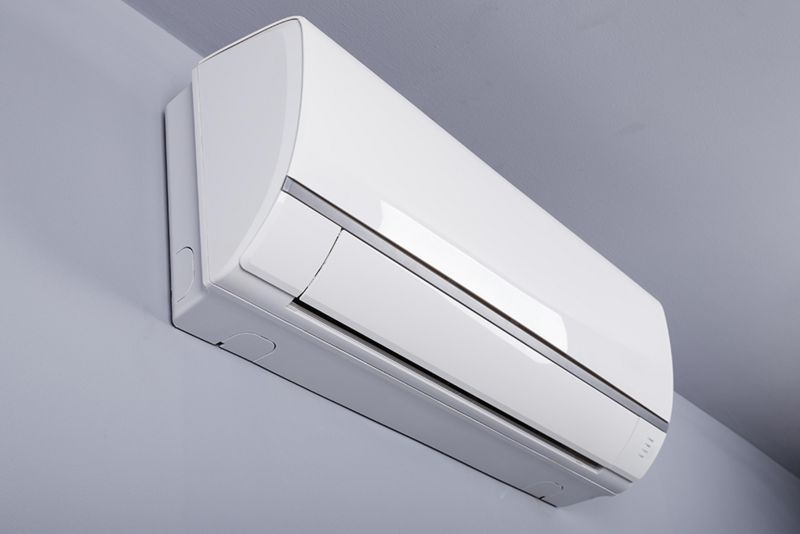
The simplest is a slender white box mounted on walls or ceilings, known as a split air conditioner.

This draws in air from a room, chills it and then blows it back out again.

In other words, it’s recirculating the air.

This is no problem for a quick visit but may be a risk over a period of hours.

A study of a restaurant in China blamed this type of air conditioner for spreading the virus.

One customer was “pre-symptomatic” – in other words, he was infected but did not realise because he had yet to develop symptoms.

Scientists reckon he released the virus as he breathed and talked, and it was pushed around the room by swirling air currents from the units on the wall.

The result was that nine other people became infected.

Dr Davies points again to the importance of fresh air:

“If there had been a good supply of outside air, very likely fewer people would have become infected – if any.”

3: Ask about the ‘fresh air ratio’

In a modern building where the windows are sealed, how can you get enough fresh air?

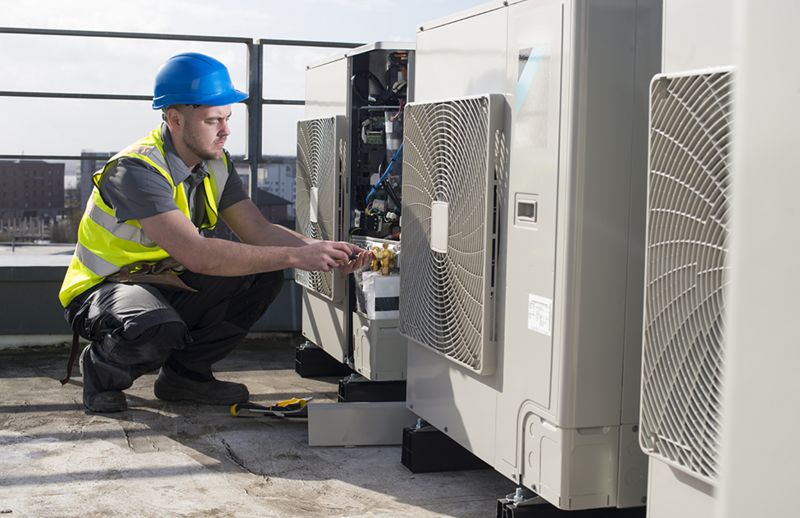
You’re relying on a ventilation system in which stale air is extracted from the rooms and piped to an air handling unit, often on the roof.

There, fresh air can be pulled in from outside and mixed with the old inside air, before being sent back into the building.

Given the risk of coronavirus infection, the professional advice is to maximise the fresh supply.

“Having 100% outside air or close to 100% is a good thing,” says Prof Cath Noakes of the University of Leeds and chair of the environmental panel of the government’s SAGE advisers, speaking in a personal capacity.

“The more fresh air, the less you’re running the risk of recirculating the virus through the building.”

The precise mix is decided by the building’s managers, who may be working for the owners or the tenants. 

The drawback to running 100% fresh air is the cost – the incoming air has to be heated in winter and cooled in summer, all of which requires energy.

4: Check if there’s virus in the filters

A modern ventilation system will have filters but these are not fool-proof.

In the US, researchers investigating the Oregon Health & Science University Hospital found that traces of coronavirus were trapped by the filters but some had somehow slipped through.

Prof Kevin van den Wymelenberg, who led the project, believes that swabbing the filters could reveal if there’s someone infected working in a building.

In South Korea, a call centre on the 11th floor of an office building saw one person infect more than 90 others.

If the filters had been checked more frequently, the presence of the virus might have been spotted sooner.

Prof van den Wymelenberg says data from filters can “show us where to punch and when to punch” in tackling infections.

5: Watch out for draughts

Talk to any expert in the field and they will say that fresh air is the key.

But one specialist in modelling the movement of air says it’s not that simple.

Nick Wirth used to design Formula 1 racing cars, and now advises supermarkets and food-processing companies on how to manage air flow to keep people safe.

He worries that if someone sitting beside an open window turns out to be infectious, they could shed virus to others downwind.

“If you open a window, where is the air going to go?” he asks. “We don’t want people in a direct line of that airflow.

“More fresh air in general is better but if it’s flowing horizontally and full of virus it could have unintended consequences.”

I put this scenario to Prof Cath Noakes.

She says the benefits of plentiful fresh air diluting the virus will outweigh any risks.

An open window might lead to more people receiving the virus but in smaller, less risky amounts, in her view.

It’s no surprise there are disagreements – there’s a lot we still don’t know about the virus.

But the air we breathe is bound to be part of any effort to make buildings safer.


All content belongs to bbc.com

We do not claim any content to be our own.

 

Coronavirus: UK to ramp up coronavirus monitoring programme

in health

In the government’s monitoring program to get a better idea of the spread of the virus, Coronavirus tests are to be carried out on more people.

The Office for National Statistics’ Infection Survey will test 150,000 people a fortnight in England by October, up from 28,000 now.

The survey is separate from the mass testing programme of people with symptoms to diagnose cases.

For the survey, a representative sample of the general population is tested.

That means it can provide estimates for the true spread of the virus.

The diagnostic testing programme, which provides daily totals, largely relies on people with symptoms coming forward.

Some people do not display symptoms when they are infected so the daily totals are an underestimate of the amount of infection that is around.

As part of the expansion of the programme, data will also be gathered in Wales, Northern Ireland and Scotland.

Coronavirus tests are to be carried out on more people in the government’s monitoring programme to get a better idea of the spread of the virus.

The Office for National Statistics’ Infection Survey will test 150,000 people a fortnight in England by October, up from 28,000 now.

The survey is separate from the mass testing programme of people with symptoms to diagnose cases.

For the survey, a representative sample of the general population is tested.

That means it can provide estimates for the true spread of the virus.

The diagnostic testing programme, which provides daily totals, largely relies on people with symptoms coming forward.

Some people do not display symptoms when they are infected so the daily totals are an underestimate of the amount of infection that is around.

As part of the expansion of the programme, data will also be gathered in Wales, Northern Ireland and Scotland.

Meanwhile, Health Secretary Matt Hancock said he wanted to see more rapid-turnaround testing for the public.

Currently most tests that are taken have to be sent off to labs to be processed – and so people often wait a day for the results.

But the government is assessing the accuracy and effectiveness of new types of tests that can deliver results on the spot.

He said this was a “huge priority” for government as it could make it easier to reopen parts of the economy and perhaps reduce the restrictions around quarantining when you come from high-risk areas abroad.

But he was unable to give a timeframe for that as the tests have not be proven to work yet.

Spotting the big picture quicker

The ONS study helps us to understand whether rising numbers of people testing positive is down to more testing or more virus.

It uses a small sample of people to inform the national picture, like tasting soup with a teaspoonful.

At the moment, spotting just 10 infections a week, it takes a while before it can tell whether a rise is a spike or just a blip.

A bigger spoon means it will spot the national and regional trends faster.

That means we’re less likely to be caught unawares if the virus comes back with a vengeance in the autumn.

But it still won’t see many infections in a town or small city, so won’t become our main local outbreak detector.

Speaking about the ONS survey expansion, he said the monitoring programme was currently the “single most important tool” the government had for making policy decisions around coronavirus because it helped it understand how the disease was spreading.

Speaking on BBC Breakfast, Mr Hancock said expanding the ONS survey would allow the government to be “more accurate and more localised” in its response.

He added that it would help the government with its “biggest challenge”, which was finding people who were asymptomatic but could still pass the virus on.

It tests thousands of people in households representative of the population, whether or not they have coronavirus symptoms.

The results help experts estimate the weekly reproduction (R) number and growth rate of the virus – which tells us if new coronavirus infections are rising or shrinking.

The survey also provides important information about the socio-demographic characteristics of the people and households who have Covid-19.

According to last week’s results, coronavirus cases across England appear to be levelling off, with an estimated one in 1,900, or 28,300 people currently infected.

Greater detail

At the start of the pilot study, led by the ONS and the University of Oxford in partnership with the Department for Health and Social Care, around 20,000 households were invited to take part, with the aim of achieving data from around 10,000 households.

Since the end of May, additional households have been invited to take part in the survey each week (roughly 5,000 a week), with an additional 15,000 households contacted in July.

By beefing up the numbers participating, the ONS will be able to assess what is going on in much greater detail.

Professor Sir Ian Diamond, the UK’s National Statistician, said that the survey would be the biggest of its kind in this country.

“Vigilance is key to containing this pandemic and the extra data on the spread of infections and antibodies at local level will be invaluable to the planning of effective local responses.”

Prof Sarah Walker, of Oxford University, who is a co-leader of the survey, added: “The added numbers will give us an awful lot of information about how this is all going to play out over the next six months.

“The key question is ‘can I get it again?’ and because we are going back to households and because we will have enough people we can answer that question, not just overall, but by age, gender and ethnicity.”

The extended survey should be up and running by October when government experts are expecting there to be surges in infection.

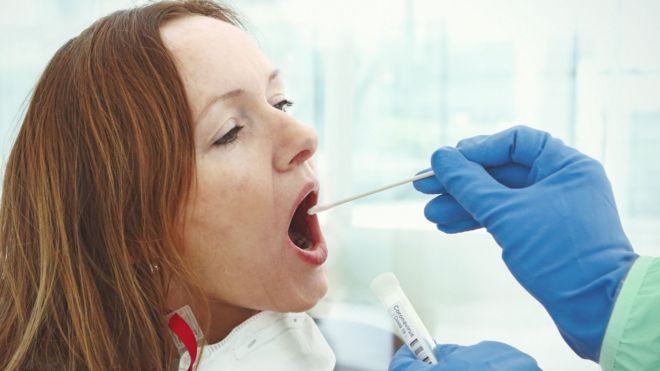
People who take part have routine nose or throat swabs to see if they currently have coronavirus.

The survey currently has 60,000 people enrolled – not all of them are tested every fortnight.

The aim is to increase this to 400,000 people across the entire project in England, and there will be proportionate increases in Scotland, Wales and Northern Ireland.

All content belongs to bbc.com

We do not claim any content to be our own.

Coronavirus vaccine: UK signs deals for 90 million virus vaccine doses

in health

For a further 90 million doses of coronavirus vaccine, the UK government has signed deals.

The vaccines are being developed by the Belgian pharmaceutical company Janssen and the US biotech company Novavax.

It means the UK has placed orders for six experimental vaccines, taking its potential stockpile to 340 million doses.

In theory, there should be enough for everyone in the UK to get five doses. Most of the vaccines require only two.

With most vaccine trials ending in failure, the government is effectively hedging its bets, hoping that at least one of the vaccines it has purchased proves safe and effective.

The price being paid has not been revealed.

Kate Bingham, chair of the UK government Vaccine Taskforce, told the BBC: “We don’t know if any of these vaccine formats that we’ve acquired will actually work. There are no licensed vaccines for any human coronavirus.”

She added it was a “priority” to ensure the UK has “sufficient vaccine” for groups “who are most at risk from coronavirus infection”.

Business Secretary Alok Sharma said: “The government’s strategy to build a portfolio of promising vaccine candidates will ensure we have the best chance possible of finding one that works.

“Today’s agreements will not only benefit people in the UK but will ensure fair and equitable access of a vaccine around the world, potentially protecting hundreds of millions of lives.”

The government has now purchased experimental coronavirus vaccines that have been developed using four different scientific approaches:

  • Adenovirus vaccines: 100 million doses Oxford University/AstraZeneca; 30 million doses Janssen
  • mRNA vaccines: 30 million doses BioNTech/Pfizer
  • Inactivated whole virus vaccines: 60 million doses Valneva
  • Protein adjuvant vaccines: 60 million doses GSK/Sanofi; 60 million doses Novavax

It takes Britain’s potential stockpile to a total of 340 million doses – one of the biggest in the world.

The Oxford and BioNTech/Pfizer vaccines are in advanced, phase three clinical trials, with tens of thousands of volunteers recruited.

It is possible that some indication on how effective they are could come in late autumn, but that is not guaranteed.

The government says if the Janssen and Novavax vaccine trials go well, the first deliveries could take place in mid-2021.

The UK has also agreed to co-fund a clinical study of the Janssen vaccine.

By the end of the year, there could be at least half a dozen different coronavirus vaccines in clinical trials in the UK – and members of the public are being encouraged to register their interest online, because without medical volunteers we will not know if any of the vaccines actually works.


All content belongs to bbc.com

We do not claim any content to be our own.
 

Go to Top