Author

Jay Foster

Jay Foster has 123 articles published.

The full list of essential businesses allowed to stay open
in politics

What shops are staying open and why do they need to close? Read our guide to find out.

Prime Minister Boris Johnson has ordered a month-long lockdown from November 5 after being told the NHS was on course to become overwhelmed within five weeks amid a national resurgence of Covid-19.

People in England are, once again, being asked to “stay at home”, with members of the public only allowed to leave their homes for a series of specified reasons, including ‘essential’ shopping.

Here’s our guide to which shops are staying open and which are being locked down.

What essential shops are open?

Food shops, supermarkets, garden centres and certain other retailers providing essential goods and services can remain open.

Essential retail should follow Covid-secure guidelines to protect customers, visitors and workers.

Non-essential retail can remain open for delivery to customers and click-and-collect.

Grocery stores will remain open and, unlike Wales, none of their aisles selling non-essential goods will be closed off.

Hardware stores and garden centres are expected to be allowed to remain open, as long as they can operate in a Covid-secure way.

What shops will be forced to close?

To reduce social contact, the Government has ordered certain businesses and venues to close.

All non-essential retailers will have to close from Thursday, meaning many shops will be closed during one of their most profitable months of the year.

These include all non-essential retail including – but not limited to – clothing and electronics stores, vehicle showrooms, travel agents, betting shops, auction houses, tailors, car washes, tobacco and vape shops.​

Non-essential retailers will still be allowed to offer click and collect services if they can be Covid-secure, as well as being able to trade online.

Are takeaways open?

Hospitality venues like restaurants, bars and pubs must close, but can still provide takeaway and delivery services. However, takeaway of alcohol will not be allowed.

Why do shops have to close?

As with pubs, restaurants and other places of social activity, the Government wants to stop any chance the virus has of spreading  between people, particularly people in groups.

Shops can help the virus to spread because it can live on surfaces for some time – so the items you pick up in the shop could be carrying the virus; you could then become infected yourself or pass it on to someone else. Scientists say that closing shops greatly reduces the risk of spreading the virus.

If fewer people get infected, there will be less strain on the NHS and more lives can be saved.

Will bike shops stay open?

As seen in the previous lockdown, bike stores will be given the green light to remain open. As all gyms and fitness centres will close their doors this Thursday, November 5th, bikes are one of the only ways people can exercise, which makes bike stores among the list of ‘essential stores’.

Will car showrooms & dealerships stay open?

Car showrooms will close their doors under the new lockdown measures and will remain closed until December 2nd, at least. However, the Government has announced that purchased cars will still be delivered to the customer’s house, while, alternatively, customers who confirmed the purchase of a car prior to lockdown will have the option to collect their vehicle from the dealership, in a system which mirrors ‘click and collect’.

Will hardware shops stay open?

The Government is yet to give the go-ahead for hardware stores to remain open throughout the upcoming lockdown, however, if the measures resemble the previous lockdown, several of these stores, including B&Q and Homebase will be able to continue to trade, as long as there are strict social distancing measures in place. Other hardware stores, including Wickes and Screwfix, operated a click and collect service; however, it is yet to be confirmed whether they will remain open for trade throughout November.

Will the Post Office remain open?

The Government has not explicitly mentioned whether the Post Office will close; however, the shop is classed as ‘essential’ and, therefore, is likely to continue to open throughout the second lockdown. This prediction comes from the measures seen in the first lockdown, when all Post Offices continued to trade, while the Royal Mail continued their postal delivery service.

Will libraries stay open?

There is no confirmation as to whether libraries will be forced to close their doors this Thursday, November 5th, as the government has not yet confirmed if libraries are deemed as an ‘essential service’. It is important to remember that schools, universities and colleges will remain open throughout November; however, the answer is likely to depend on whether libraries are able to maintain successful social distancing measures.

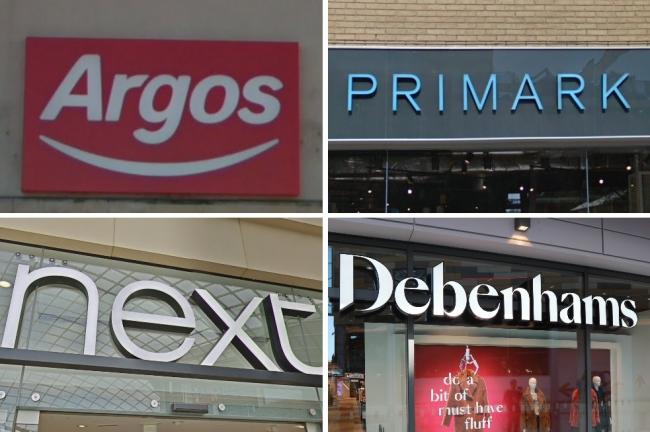
Will Argos close?

Yes, all Argos stores across England will close their doors throughout the entirety of the second national lockdown, and will only reopen when the country enters its ‘exit strategy’ on December 2nd. The closures include Argos inside Sainsbury’s supermarkets; however, the store is still offering delivery when you order online throughout November.

Oxfam Store before England enters lockdown on Thursday, 5th November
The front of an Oxfam store near Durham, as non-essential shops prepare to close their doors once again CREDIT: Tom Wilkinson/PA

Can I still go to the dentist?

Unlike the previous lockdown, dentists will remain open and will continue to welcome patients for routine appointments. This move comes after the Prime Minister encouraged people not to neglect their NHS appointments, despite the severe new lockdown measures.

Can I still visit a garden centre?

Yes, garden centres will remain open throughout the latest lockdown, as they are among the essential stores, to sell goods which the public will need to access throughout November. However, it is vital these centres follow the appropriate social distancing measures in order to keep shoppers safe throughout the new lockdown.

Will estate agents close?

The housing secretary, Robert Jenrick, suggested that the housing market will remain in business throughout the second lockdown, in a statement which contrasts the rules of the first lockdown in March. However, there has been no word on whether estate agents will be physically forced to close their doors over the coming month, as all ‘non- essential retail’ will pause until December 2nd.

 Will golf courses stay open?

The Government is yet to confirm whether golf courses will receive a green light to remain open over the lockdown; however, the confirmation is likely to come in the following day. There is, however, a suggestion that courses may remain open as they offer the opportunity to exercise and are easy to implement social distancing measures.

All content belongs to https://www.telegraph.co.uk/news/0/non-essential-shops-closing-full-list-essential-businesses-allowed/

We do not claim any content to be our own.
Celebrities narrate ‘groundbreaking’ audio-trail

in Croydon

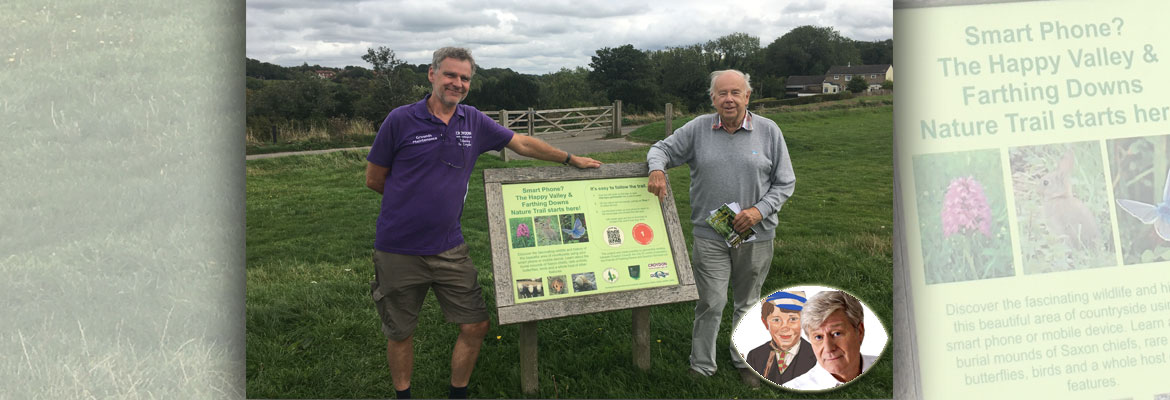
One of the highlights of a relaunched nature trail in Coulsdon is a star-studded line-up of narrators which also boasts a 64-page full colour booklet.

Joanna Lumley, Benjamin Zephaniah, Noddy Holder, Martin Jarvis, Miriam Margolyes, Gyles Brandreth, Tony Robinson and Richard O’Brien are just some of the celebrities who have volunteered their time to narrate sections of the trail which can be accessed by smartphones using QR codes on 29 marker posts.

Actor Martin Jarvis knows the area well having grown up in South Norwood then South Croydon. He said, “Doing the narration stirred up so many nice memories of my childhood. We used to go on rambles around the Downs but I wasn’t at all educated about it as this trail will help teach everybody. I’ve done two separate narrations and one about a particular pond is my favourite because it reminds me of a character I later became associated with – William in the Just William stories who is very keen on ponds.”

The relaunched trail and booklet were organised by the Friends of Farthing Downs and Happy Valley and made possible by a grant from the City of London Corporation and the energy and enthusiasm of Croydon Council’s countryside warden, Dominic North, who spent his spare time contacting celebrities, editing the material, then adding suitable soundscapes as backdrops to their voices.

He said, “Originally I was going to narrate the whole thing but when I put my voice on tape I thought people would get bored! So I came up with the plan to contact well-known people and I must have written to 150 of them including personal heroes like Bob Dylan! I’ve ended up with one celebrity each doing a couple of posts and I have to say I don’t know of another nature trail quite like this where so many famous people have been involved.”

As well as enjoying the distinguished voices, visitors to the trail will also be able to use the QR codes to access a library of information relating to that particular location.

“This is fantastic work from Dominic and the Friends group and I can’t wait to hear this host of A-listers guide me through Happy Valley and Farthing Downs while browsing through the beautiful-looking booklet. Walking the whole trail takes about three hours so it’s also an excellent way to encourage people to get active and explore some of our great outdoors.

“The whole project is a fine example of cross-partnership working between Croydon, the City of London Corporation and the Friends and I hope these imaginative resources bring a whole new audience to our treasured area”

Councillor Oliver Lewis, cabinet member for culture, leisure and sport

Roughly half of the marker posts can be found in Happy Valley (owned by Croydon Council) and half in Farthing Downs (owned by the City of London Corporation). These areas, together with adjacent open spaces at Coulsdon Common, Kenley and Riddlesdown, form part of a newly designated South London Downs National Nature Reserve – only the third National Nature Reserve in London.

Graham Lomas, chair of the Friends of Farthing Downs and Happy Valley said, “I hope these initiatives will encourage more people to visit these much-loved, historic open spaces. What Dominic has achieved in his audio-trail is not just delightful but groundbreaking and we also plan to add translations so visitors will be able to hear everything the celebrities have said in their own language.

“My other hope is that more schoolchildren and college students will now engage with the Downs and Happy Valley and I would love to see schools in the area that are studying biology use the material that we’ve provided.”

The audio-trail is now live and you can access it through the link http://goo.gl/GAeAZk which also features a text version of the trail.

All content belongs to croydon.gov.uk

We do not claim any content to be our own.

Statement from Rachel Flowers, Croydon’s director of public health

in Croydon

Croydon’s Director of Public Health, Rachel Flowers said: “As of today, London is now on the national Covid-19 watch list. The number of cases in Croydon is increasing and last week I raised our area risk level from low to medium.

“We must remember that while for many Covid-19 is a mild illness for others, particularly our older and most vulnerable residents, it can be devastating. It is therefore crucial that everyone in Croydon acts now to protect themselves, their friends and family and wider community.

“This means always following the public health advice to prevent the spread of infection:

  • Hands, face, space – keep washing your hands regularly for at least 20 seconds, wear a face covering in enclosed spaces and always keep a 2m distance from others outside your household.
  • Always follow the rule of six – you must not meet in groups larger than six with some limited exceptions. Visit www.gov.uk/coronavirus for the latest government guidance.
  • If you have any of the Covid-19 symptoms – a new continuous cough; a high fever; a loss of taste or smell – you MUST self-isolate and get tested. You should only be leaving your home to get a test. Find out more about symptoms and book a test online at www.nhs.gov.uk/coronavirus or call 119.

If we all play our part, together we can help to keep Croydon safe.”

All content belongs to croydon.gov.uk

We do not claim any content to be our own.

Coronavirus: London placed on Covid-19 watch-list as cases rise

in health

Due to the rise in cases in the city, officials have said, London has been added to the government’s Covid-19 watch-list.

All boroughs have been classed as areas of concern, but no additional restrictions have been announced.

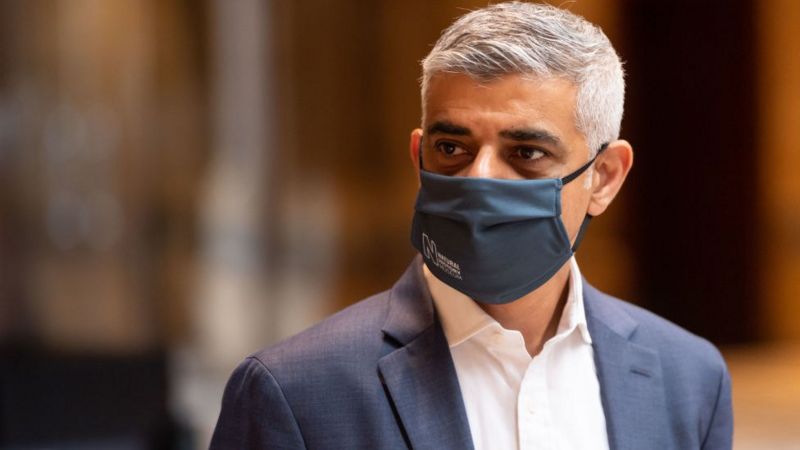
Mayor of London Sadiq Khan said the city was at “a worrying tipping point” with hospital admissions increasing.

Councils in the city have urged residents to abide by current restrictions.

The watch-list, published each week, categorises local councils seeing a higher infection rate as “areas of concern”, “areas of enhanced support” or “areas of intervention”.

Tighter restrictions are usually introduced for areas in the third category.

Earlier on Friday, London Councils – the group representing all 33 local authorities in the city – announced the city would be joining the list, saying it was a “stark reminder” to residents they must follow new rules announced this week.

The organisation called for a sustained boost to Covid-19 testing in the capital so infections can be monitored.

Sadiq Khan said the city had seen “a sharp rise” in NHS 111 calls, hospital admissions and patients in intensive care due to coronavirus

Mr Khan said testing capacity had been “diverted away” from the capital to other national hotspots, causing the number of tests in the city to drop by 43%.

“The lack of testing capacity is totally unacceptable,” he said.

“It’s vital that testing capacity is increased immediately in London and focused in the areas it is needed most. Any delay will mean letting the city down and will cost lives.”

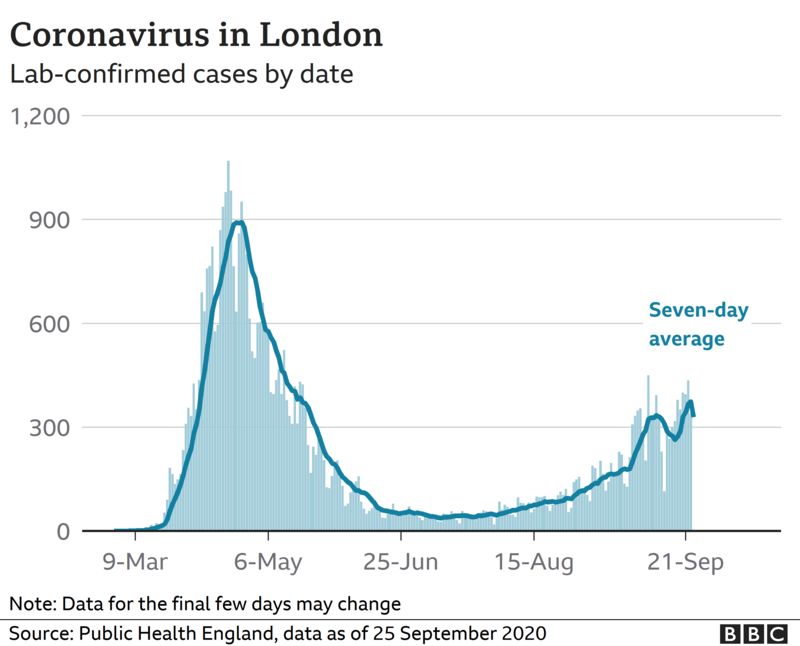
The most recent daily figures showed 584 coronavirus cases were reported across London. In the week to 21 September, Redbridge had the highest infection rate per 100,000 residents compared with other boroughs, at 55.4.

All content belongs to bbc.com

We do not claim any content to be our own.

London coronavirus: What a London lockdown could look like as city may be ‘days behind’ North East

in health

More areas of the UK are speculated that could see coronavirus restrictions extended in the coming weeks.

London Mayor Sadiq Khan is pressing ministers to extend the controls to London, which he believes may be just “two or three days” behind the hotspots of the North West and North East of England.

In the face of heightened criticism the government has made a series of announcements in the last 24 hours signalling an increasing tougher approach to the coronavirus outbreak.

The government announced yesterday (September 19) anyone in England who refuses an order to self-isolate could face a fine of up to £10,000.

Health Secretary Matt Hancock spoke this morning and warned Britain is at a “tipping point” as he refused to rule out a second national coronavirus lockdown if the public fails to follow social distancing rules.

With cases rising across the country, Mr Hancock said there was a danger the numbers could “shoot through the roof” unless effective action was taken to halt the spread of the virus.

Much of the countries population are already living under increased restrictions, so when considering what may happen in London over the next few weeks, if infection rates continue to rise, it makes sense to look at what is already in place across the UK.

People in the North East, North West and the Midlands are all living under tighter coronavirus, as is Bolton, which has the highest infection rate in the UK.

Below you will find the coronavirus rules in some areas of England that could soon be arriving in London:

North East

Durham, Gateshead, Newcastle, Northumberland, North Tyneside, South Tyneside and Sunderland

Hospitality venues must only sell food and drink for consumption on the premises if it is served to customers sitting at a table – they may also sell food and drink for consumption off the premises.

Hospitality venues include: Restaurants (including hotel dining rooms and members’ clubs), cafes, bars (including bars in hotels or members’ clubs), pubs, social clubs and casinos.

The following businesses and venues must close from 10pm to 5am each day:

  • Restaurants, including hotel dining rooms and members’ clubs
  • Cafes
  • Pubs
  • Bowling alleys
  • Social clubs
  • Cinemas
  • Theatres
  • Casinos
  • Amusement arcades or other indoor leisure centres or facilities
  • Funfairs (indoors or outdoors), theme parks and adventure parks and activities
  • Bingo halls
  • Concert halls

If you live in one of the affected areas, you must not:

  • Host people you do not live with in your home or garden, unless they’re in your support bubble.
  • Meet people you do not live with in their home or garden, whether inside or outside of the affected areas, unless they’re in your support bubble.

You should also try not to share a car with those outside your household or support bubble.

Bolton

The following businesses and venues must not open in Bolton:

Casinos

Skating rinks

Bowling alleys

Indoor play areas, including soft play areas

Exhibition centres and conference halls for external attendees

Hospitality venues must only provide take away food and drinks or delivery services to customers – this includes restaurants, cafes, bars, pubs.

The following businesses and venues must close from 10pm to 5am each day:

Venues listed above (now only operating as takeaways)

Cinemas

Theatres

Bingo halls

Concert halls

Museums and galleries

Betting shops

Nail bars and salons, hair salons and barbers

Tanning booths and salons

Spas and beauty salons

Massage parlours

Tattoo and piercing parlours

Amusement arcades or other indoor leisure centres or facilities

Funfairs (indoors or outdoors), theme parks and adventure parks and activities

Playgrounds

Social clubs

Aquariums and zoos, including safari parks

Indoor attractions at visitor attractions

If you live in Bolton, you must not:

Host people you do not live with in your home or garden, unless they’re in your support bubble.

Meet people you do not live with in their home or garden, whether inside or outside of Bolton, unless they’re in your support bubble.

You should also try not to share a car with those outside your household or support bubble.

West Midlands

Birmingham, Sandwell, Solihull and Wolverhampton (from Tuesday 22 September)

If you live in the affected local areas, you must not:

  • Host people you do not live with in your home or garden, unless they’re in your support bubble.
  • Meet people you do not live with in their home or garden, whether inside or outside of the affected areas, unless they’re in your support bubble.

You should also try not to share a car with those outside your household or support bubble.

North of England

Greater Manchester, East Lancashire, Preston, and West Yorkshire

If you live in one of the affected areas, in order to help prevent the spread of coronavirus you must not:

  • Host people you do not live with in your home or garden, unless they’re in your support bubble.
  • Meet people you do not live with in their home or garden, whether inside or outside of the affected areas unless they’re in your support bubble.

You should also try not to share a car with those outside your household or support bubble

All content belongs to mylondon.news

We do not claim any content to be our own.


Covid-19: Tighter national rules considered for England by government

in health

For a few weeks pubs and restaurants could be shut  as part of stricter measures across England to slow the surge of coronavirus cases.

The government is considering a short period of tighter rules which could be announced in the next week, BBC political editor Laura Kuenssberg said.

Schools and most workplaces would be kept open during those weeks.

Health Secretary Matt Hancock told the BBC the government is “prepared to do what it takes” against Covid-19.

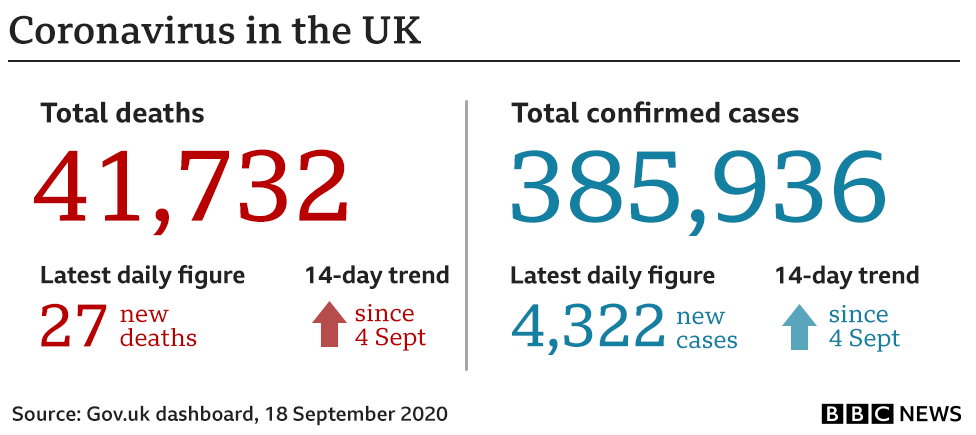
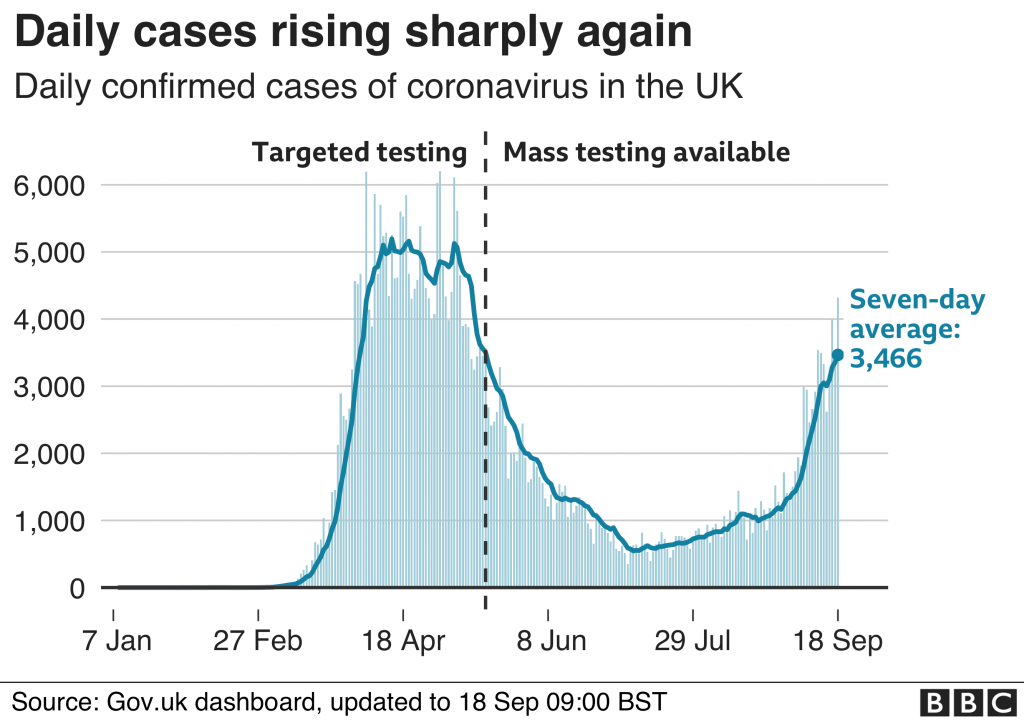
It comes as the UK recorded a further 4,322 confirmed cases of coronavirus – the first time the daily total of positive tests has exceeded 4,000 since 8 May.

Another 27 deaths were reported within 28 days of a positive test.

Described by the government as a “circuit-break”, the measures being considered could involve re-introducing restrictions in public spaces for a period of a few weeks. Schools and workplaces would stay open.

Ideas suggested by the government’s Scientific Advisory Group for Emergencies (Sage) include closing some parts of the hospitality sector.

No 10 is also considering limiting the opening hours of pubs and restaurants across the country, as has already happened in some areas.

Mr Hancock said there had been an “acceleration” in cases in the last couple of weeks, with the number of people admitted to hospital doubling about every eight days.

He stressed it was “critical” that people followed social distancing guidelines and local lockdown rules, where they applied, to “avoid having to take serious further measures”.

The Office for National Statistics’ weekly infections survey for England and Wales, used by the government to base its decisions, estimates there were about 6,000 new cases a day in England in the week to 10 September.

‘Circuit-break’

Scottish First Minister Nicola Sturgeon has said the next few days will be “critical” to avoid another full-scale lockdown in Scotland.

Ms Sturgeon, Welsh First Minister, Mark Drakeford, and Labour leader Sir Keir Starmer have all asked Boris Johnson for an emergency Cobra meeting to be called.

At a meeting on Wednesday night, the UK government’s chief scientific adviser and medical adviser said they were forecasting a significant number of deaths by the end of October if there were no further interventions.

Basic maths shows us how quickly coronavirus cases can, theoretically, soar.

Around 4,000 infections a day, doubling every eight days, would be 128,000 new daily cases by the end of October.

That is not guaranteed to happen, and a change in our behaviour, the “rule of six” or restrictions like those in north-east England could improve the situation.

The point of a national “circuit-break” would be to achieve a controlled drop in the levels of coronavirus without needing a full lockdown.

This does two things, obviously it helps avoid having very high levels of the virus that could overwhelm hospitals.

But it also gives us more options. Any contact tracing programme or system of local lockdowns is far easier to implement when levels of the virus are low. The higher the number of cases, the fewer targeted measures the government has to use.

The problem is once the circuit-break is over, cases would begin to rise again and it may take multiple circuit breaks to get us through winter.

Meanwhile, new rules have been announced for north-west England, the Midlands and West Yorkshire, to come into force from Tuesday, in an effort to control the spread of the virus.

Similar restrictions have already come into force in north-east England, affecting almost two million people, banning them from meeting people from other households and requiring restaurants and pubs to shut at 22:00 BST.

But it is understood the government turned down down a request from the local council in Leeds to bring in early closing for bars and pubs there.

Other parts of the UK under local lockdown conditions include – including Birmingham, Greater Manchester, Caerphilly, and the Belfast council area.

The four nations of the UK are in charge of their own lockdown restrictions, with Scotland, Wales and Northern Ireland implementing slightly different rules to England.

The health secretary said the government’s current approach was “targeted interventions” and stressed “a national lockdown was the last line of defence”.

“The strategy is to keep the virus down as much as is possible whilst protecting education and the economy,” Mr Hancock added.

“And throw everything at the science which eventually is the way we’re going to spring out of this.”

Prime Minister Boris Johnson is understood to be deeply reluctant to order another national lockdown, where everyone would be asked to stay at home and businesses to close.

Earlier this week he described the potential impact of this on the economy as “disastrous”. Chancellor Rishi Sunak is also understood to have warned ministers of the potential damage to the economy.

The government is also concerned about the impact of more restrictions on daily life on those who need treatment for non-Covid related illnesses.

In other key developments:

All content belongs to bbc.com

We do not claim any content to be our own.


Council to further expand scheme to boost walking and cycling

in Croydon

The next phase of the borough’s Streetspace scheme launches on 28 September four more Croydon streets will become safer, greener, quieter, and more cycle-friendly.

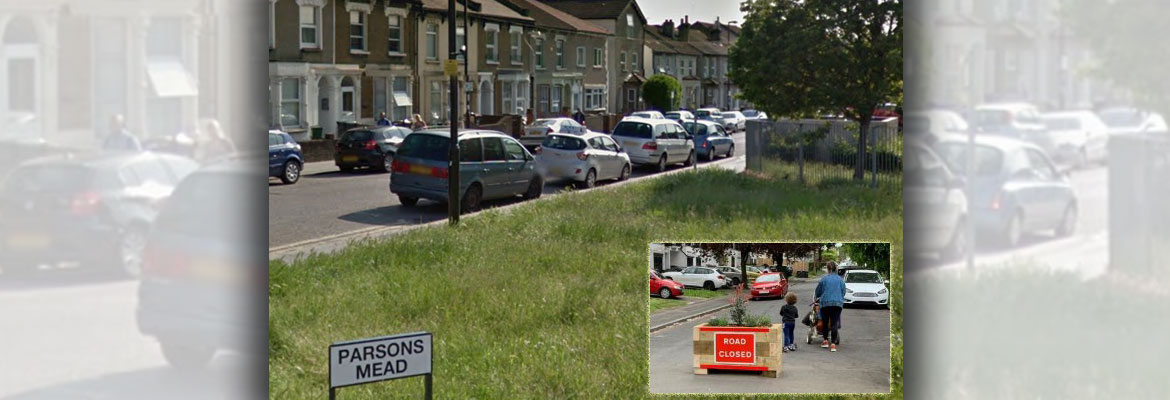
Croydon Council will use planters and signs to transform four more streets into places to walk, cycle and exercise while maintaining car access for their residents.

The scheme, which the council developed using suggestions from local residents, aims to reduce the number of cars cutting between Mitcham Road and London Road, and covers Derby Road, Handcroft Road, Mead Place and Parsons Mead.

Broad Green’s new Low Traffic Neighbourhood is part of the council’s Streetspace programme, which is funded by Transport for London (TfL) and is a response to legislation from central government allowing local councils to put in place measures that encourage walking and cycling. The council’s latest Broad Green initiative, introduced under a Temporary Traffic Regulation Order, follows similar schemes and brings the borough total to 20.

Ahead of these changes, the council informed around 1,900 residents, businesses, community groups, local representatives and emergency services, and installed advance warning road signs. Exemptions will be in place for permit holders and emergency vehicles.

The changes for each of the affected new streets are:

  • Derby Road will be closed to through traffic using planters at the junction with Parsons Mead. New double yellow lines will ensure parked vehicles do not obstruct turning vehicles.
  • Mead Place: The current one-way direction will be reversed at the junction with Parsons Mead to limit traffic exiting onto London Road.
  • Parsons Mead: At the junction with Gardeners Road, traffic will be restricted to those with permits and emergency vehicles, and this will be monitored through special ANPR cameras.
  • Handcroft Road: Will be made one-way northbound, with vehicles exiting on London Road. This will prevent through traffic using Handcroft Road to bypass the London Road. There will be better access for cyclists through a new southbound cycle lane.

As with other Streetspace schemes, the council welcomes ongoing feedback and will take this into account when deciding whether the scheme should be made permanent, amended or removed. A formal consultation will be carried out on any proposals to make the scheme permanent.

Councillor Muhammad Ali, Croydon Council’s deputy cabinet lead for transport and the environment and also a Broad Green ward councillor, said: “Data from TfL has found that more than half a million daily Croydon car journeys could be taken on foot or by bicycle, so unlocking this potential could have massive benefits for our residents’ health. During Covid-19, helping families stay fit and healthy is more important now than ever.

“We recognise that not all trips can be made on a bicycle. If successful, this scheme would actually see a reduction in traffic, making it easier to drive in the area for those that need to, as people feel increasingly empowered to leave the car at home more often. In Derby Road alone there have been several collisions in recent years, so cutting through traffic will make these roads quieter and safer.”

For more information, visit the council website.

All content belongs to croydon.gov.uk

We do not claim any content to be our own.

Building bee highways and butterfly corridors and how you can play your part

in Croydon

Croydon Council is busy establishing more wildflower and bee and butterfly-friendly road verges and habitats across the borough.

Working alongside the London Wildlife Trust a number of sites have been targeted to improve the environment for wildlife and wildflowers as part of the council’s Bee Highways and Butterfly Corridors campaign. At the current time two chalk banks are being created in Milne Park and scrapes to expose chalk are taking place in Falconwood Meadow and Foxley Wood. Wildflowers grow well in chalk grassland. Bradmore Green was also recently re-seeded to create a wildflower area.

There are also plans for wildflower areas in Sanderstead Recreation Ground and Higher Drive Recreation Ground, while mowing regimes are changing across the borough to ensure more wildflowers grow on road verges and so encourage a greater number of birds, butterflies and wildlife.

Resident Judith Johnson, who lives in Ellenbridge Way, South Croydon is thrilled that a change in the mowing regime has resulted in orchids and other wildflowers being allowed to flower in the road verges close to her home.

She said, “The council maintains a one-metre edge to the wildflower area which shows the residents that what they are doing is deliberate but the rest is left to grow into a glorious meadow. We’ve had ox eye daisies and birds foot trefoil and lots of bees, birds and butterflies and it will be even better next year because every year the actual grass subsidies and the wildflowers take over. I applaud the council for just letting the grass grow and it has been a joy to behold.”

If any residents would like to nominate their road to be a ‘wildlife friendly road’ by changing the mowing regime of their road verge to encourage more wild flowers they can register their interest by emailing biodiversity@croydon.gov.uk Residents need to be able to commit to assist with the raking up of any cut grass and vegetation once or twice a year and seek the agreement from the majority of residents in their street.

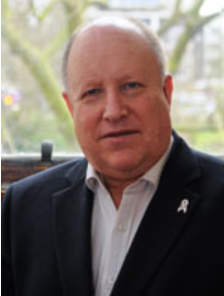
“Following the success of the Street Champions we are asking what part you can play in taking pride in our area and help maintain the beautiful wildflower verges and habitats we are setting up across Croydon.
“We are already an incredibly green borough but we want to do more and the creation of wildflower areas is crucial to this vision. More wildflowers means greater biodiversity and a home for more bees, butterflies, insects and birds. We are already working hard in matters such as recycling and street cleaning but allowing nature to thrive is of paramount importance as we look to the future”

Councillor Stuart Collins, deputy leader – Clean Green Croydon

The focus of creating more wildflower meadows is also part of a two-year project, funded by the People’s Postcode Lottery and delivered in collaboration with the London Wildlife Trust, Butterfly Conservation and Natural History Museum called Brilliant Butterflies.

The aim is to create a ‘living landscape’ of chalk grassland in areas across Croydon and work with communities to create butterfly colonies in their local green spaces.

Catherine Cullen, project manager for the Brilliant Butterflies project said, “Croydon was chosen because of its amazing chalk grassland. It’s a rare habitat and 80% of it has been lost since 1945. So we’re working hard to conserve it and our project also involves work in four nature reserves in south Croydon. In certain conditions you can get up to 40 different species of wildflower in a square metre and that in turn supports lots of pollinating insects and butterflies. The more we endeavour with this project the more people in Croydon realise what incredible wildlife they have on their doorstep.”

All content belongs to croydon.gov.uk

We do not claim any content to be our own.

Croydon acts now for a sustainable future

in Croydon

To meet its significant financial challenges and secure a sustainable future for the borough, Croydon Council is taking immediate action.

Cabinet members are set to consider a report on Monday asking officers to urgently develop Croydon’s renewal plan, which would be submitted to central government asking for its support.

Like many local authorities, Croydon Council has been badly affected by the financial consequences of the Covid-19 pandemic and the increased costs and loss of income that has created. This is on top of a decade of funding decreases from central government.

The council has already taken significant steps to reduce its costs, but the scale of its financial challenge means further immediate action is required. Working with the government on a financial support package would allow Croydon to implement a plan over the next two to three years to transition the council into a more financially sustainable and resilient position.

The plan will set out changes to the whole organisation of the council, putting it on a stronger footing for the future. It will include phased and managed reductions in services to deliver significant savings over next three years and bridge its budget gap.

This will give the council time and space, amid the continuing difficult financial climate to make fundamental changes to the organisation, increase reserves and deliver a resilient and sustainable budget for the future.

The council is committed to working with residents, staff, local business and partners to help shape its future and determine what services are a priority for the borough.

“Croydon’s plan will set out how we are taking swift and decisive action to protect priority services for our residents. Our borough is facing significant financial challenges following its 24/7 response to the Covid-19 pandemic, on top of a decade of funding decreases. We need to change the way we do things now to ensure we can continue to deliver the services on which local people depend, particularly our most vulnerable residents.

“This is hugely important for Croydon and I am calling on everyone to work together to make this happen. We want our staff, residents and partners at the heart of this process and we will be listening to them throughout so that together we create a council that meets local needs in a way that is sustainable for the future.”

Councillor Tony Newman, leader of the council

If you want to help shape Croydon’s future, send your views to: croydonplan@croydon.gov.uk

All content belongs to croydon.gov.uk

We do not claim any content to be our own.


Coronavirus: England and Wales’ contact-tracing app gets launch date

in health

The government has announced that on 24 September, a new Covid-19 contact-tracing app will be launched across England and Wales.

The app will let people scan barcode-like QR codes to register visits to hospitality venues and will implement Apple and Google’s method of detecting other smartphones.

Businesses are being asked to display QR code posters to support the app.

Health Secretary Matt Hancock described the launch as “a defining moment”.

The first version of the NHS contact-tracing app, intended for the whole of the UK, was trialled on the Isle of Wight in May but later abandoned.

“We need to use every tool at our disposal to control the spread of the virus including cutting-edge technology,” said Mr Hancock.

“The launch of the app later this month across England and Wales is a defining moment and will aid our ability to contain the virus at a critical time.”

According to the latest figures published by the Office for National Statistics, there were an estimated 3,200 new cases a day in England during the first week of September, compared with 2,000 the week before.

Some hospitality venues have already been using their own QR code-based systems for test and trace but are now being asked to switch to the NHS version instead.

Universities, hospitals, leisure premises, civic centres and libraries are being asked to display posters in communal areas such as cafes, where people gather for longer than 15 minutes.

An alternative system, such as a handwritten register, must also be maintained for visitors who do not have smartphones, the Department of Health and Social Care said.

Welsh Health and Social Services Minister Vaughan Gething said launching a joint app with England was “the most practical option”.

He added that the move reflects “movement across our shared border”.

“It makes sense to use the same app, working in exactly the same way, regardless of which country you’re in.”

It has had a long and troubled gestation but the team behind the NHS Covid-19 app are hoping that they’ve finally got it right at a time when it can make a significant contribution to limiting the spread of the virus.

Back in April, an app seemed to be a key weapon in the government’s armoury but since Baroness Dido Harding took over the Test and Trace programme, it’s been relegated to the “cherry on the cake”.

Around the world there are still doubts amongst those working on contact tracing apps about just how good Bluetooth is as a way of measuring the distance between people.

But the fact that pubs, restaurants and other hospitality businesses are now being told they have to do a better job of logging contact details of visitors presents an opportunity.

They may now see having QR codes for visitors as a simple way of complying with the rules, and that could encourage take-up of the app.

There has been some confusion about whether businesses will be complying with the rules on collecting customer data if they rely on the app. But I’ve been told that they will be compliant even though the nature of the app means none of the data will be visible either to them or to the authorities.

Scotland launched its own app on Thursday that has already been downloaded nearly 600,000 times.

The Protect Scotland app informs people if they have been in close contact with someone who later tests positive.

Northern Ireland was the first part of the UK to launch a contact-tracing app – StopCOVID NI was officially launched at the end of July.

In England, from Monday, social gatherings will be limited to up to six people – in a measure dubbed “the rule of six”.

It has been criticised by some Conservative MPs who have said it should be subjected to more parliamentary scrutiny.

Scotland and Wales – which along with Northern Ireland have devolved powers to set their own coronavirus restrictions – also reduced the size of social gatherings to six people from Monday.

In Scotland, children under the age of 12 will not count towards the total, and in Wales the rule will not apply to children under 11 and up to 30 people can still meet outside.

The new measures followed a sustained rise in coronavirus cases, with over 2,000 positive cases recorded across the UK on five consecutive days this week.

All content belongs to bbc.com

We do not claim any content to be our own.

1 2 3 13
Go to Top